
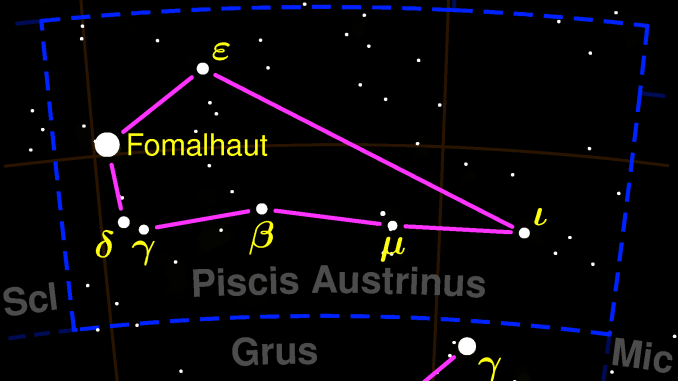
Piscis Austrinus, the Southern Fish, is an ancient constellation best known for containing Fomalhaut, one of the brightest stars in the night sky. Although most of its stars are relatively faint, Fomalhaut shines at magnitude +1.2, making it an unmistakable landmark in the autumn sky. The constellation covers approximately 245 square degrees, ranking 60th among the 88 modern constellations. Its name means “Southern Fish” in Latin, distinguishing it from the zodiacal constellation Pisces farther north.
Where and When to Find Piscis Austrinus
Piscis Austrinus lies south of Aquarius, near Capricornus, Sculptor, and Grus. For Northern Hemisphere observers, the constellation is best seen on autumn evenings, particularly from September through November. From southern latitudes, it appears considerably higher in the sky.
The easiest way to locate Piscis Austrinus is to find Fomalhaut, its brilliant white star. During Northern Hemisphere autumn, Fomalhaut appears low in the southern sky, often standing out because there are few other bright stars nearby. The remaining stars form a much fainter outline representing a fish, with Fomalhaut marking its mouth.
From the United Kingdom and similar northern latitudes, the constellation remains relatively low above the horizon, so an unobstructed southern view is helpful.
Mythology — The Southern Fish
Piscis Austrinus is one of the oldest recognized constellations and was included among the 48 constellations described by the Greek astronomer Ptolemy in the second century AD. Its origins extend further back to Mesopotamian astronomy, where a celestial fish was associated with the waters of the sky.
In Greek star lore, Piscis Austrinus is often depicted drinking water poured from the jar carried by Aquarius. Some traditions also connect the Southern Fish with the two fish of the zodiacal constellation Pisces, although the stories vary between ancient sources. The constellation’s distinctive relationship with Aquarius survives in traditional star charts, where a stream of water flows directly toward the fish’s mouth.
Notable Stars in Piscis Austrinus
Fomalhaut — The Mouth of the Fish
Fomalhaut (Alpha Piscis Austrini) is the brightest star in Piscis Austrinus and one of the 20 brightest stars in the night sky. Located approximately 25 light-years away, Fomalhaut is a white main-sequence star nearly twice as massive as the Sun. Its apparent magnitude of +1.16 makes it easy to see without optical aid. Its name comes from an Arabic expression meaning “mouth of the fish,” reflecting its position in traditional depictions of the constellation.
Fomalhaut is particularly interesting because it is surrounded by an extensive disk of dusty debris, providing astronomers with an opportunity to study material left over from planetary formation.

Other Notable Stars
- Epsilon Piscis Austrini is a hot blue-white star shining at approximately magnitude +4.2. Although considerably more luminous than the Sun, its great distance makes it much fainter than Fomalhaut.
- Delta Piscis Austrini is an evolved yellow giant and multiple-star system, also shining near magnitude +4.2.
- Beta Piscis Austrini is another relatively faint star contributing to the traditional outline of the Southern Fish.
- Lacaille 9352 is a nearby red dwarf approximately 10.7 light-years from Earth. Despite its proximity, the star is too faint to see without a telescope.
Notable Deep-Sky Objects
Piscis Austrinus contains no Messier objects, and its deep-sky targets are generally faint galaxies requiring telescopes.
NGC 7173, NGC 7174, and NGC 7176
Three of the constellation’s most interesting galaxies are NGC 7173, NGC 7174, and NGC 7176, members of a compact grouping associated with Hickson Compact Group 90. Located roughly 100 million light-years away, these galaxies are close enough to influence one another gravitationally. NGC 7173 and NGC 7176 are elliptical galaxies, while NGC 7174 has a more disturbed appearance, with dust and irregular structure associated with gravitational interactions. Astronomical images reveal how galaxies can be distorted and stripped of material during encounters with their neighbors.
These objects are considerably fainter than the stars of Piscis Austrinus and are best suited to larger telescopes or astrophotography.
Observing Piscis Austrinus
For most stargazers, Fomalhaut is the main attraction. Its brightness and relatively isolated position make it one of the easiest stars to recognize in the autumn southern sky. Binoculars can help reveal some of the constellation’s fainter stars, although its outline remains less obvious than that of neighboring constellations. The distant galaxies offer more challenging targets for experienced observers.
With its ancient mythology, brilliant Fomalhaut, and intriguing debris disk, Piscis Austrinus is a reminder that even a relatively obscure constellation can contain one of astronomy’s most fascinating nearby star systems.